Jonghoon Ahn.Video Algorithms · Gaussian Splatting · Neural Graphics
Selected research for video algorithms / neural graphics

From 3D representations to practical media systems.

I approached Gaussian Splatting as a systems question, not only as a reconstruction technique. A useful representation has to look good, train efficiently, fit within a transferable payload, and execute efficiently once it reaches a device.

This portfolio follows one connected research path across representation quality, training cost, compression, and runtime systems. Each experiment exposed the next bottleneck.

Research snapshot
3DGS payload2.65×185.43 to 70.04 MiB
Selected quality27.62dB after prune + FP16
Representation study2 scenesBonsai + Garden
Spatial acceleration444×SAH BVH vs brute force
The numbers are useful only with context. The sections below explain why each experiment was run, what changed, what failed, and why the next experiment followed.
The question

What would it take to move Gaussian Splatting from an impressive reconstruction technique toward a practical media representation?

A trained scene can look excellent and still be difficult to use. It may take too long to optimize, grow into a large representation, compress poorly, or behave unpredictably across runtime conditions. I broke that larger problem into four connected questions.

A practical 3D representation has to survive four tests: representation, training, delivery, and execution.

I did not treat these as independent portfolio pieces. I used each result to decide what bottleneck to investigate next.

Each experiment exposed the next bottleneck.
Research journey

One question, four layers of evidence.

The sequence matters. I first asked whether 3DGS was promising under a controlled comparison, then investigated training cost, then payload size, and finally the systems side of scene execution.

01 · REPRESENTATION

NeuralScene Bench

Before optimizing Gaussian Splatting, I needed to understand what advantage the representation actually offered.

I compared Splatfacto and Nerfacto TCNN under the same Nerfstudio parser, held-out split, image scale, camera treatment, and nominal 5K iteration budget. Splatfacto reached higher held-out reconstruction quality on both Bonsai and Garden.

The quality gap is also visible in held-out reconstructions. Fine foliage, thin geometry, and local texture structure remain closer to the reference in the tested Splatfacto outputs. I treat runtime throughput separately because repeated evaluation showed that evaluator FPS is implementation and execution-condition sensitive.

Bonsai +2.14 dB PSNRGarden +1.66 dB PSNRcamera optimizer offmatched 5K nominal budget
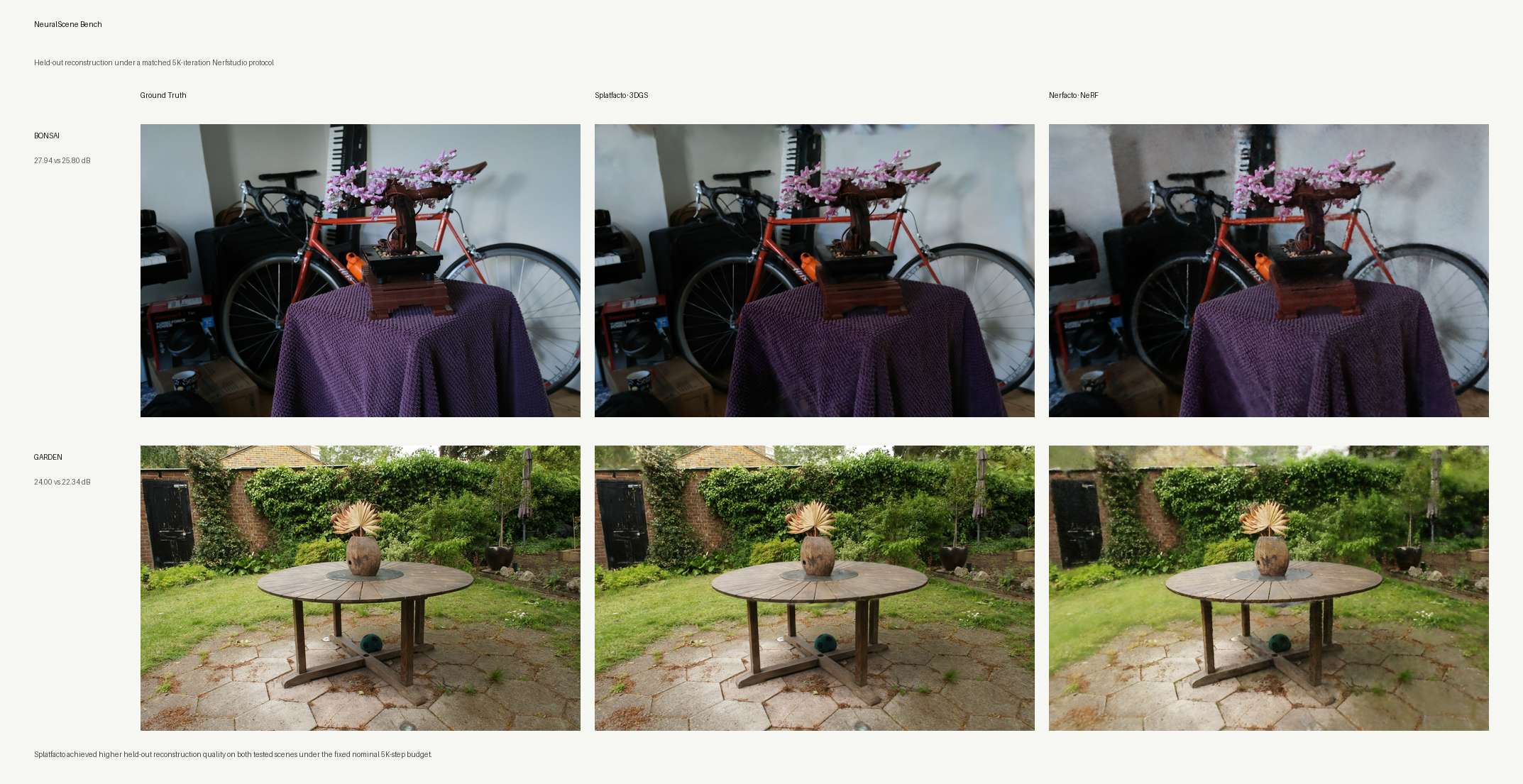
Held-out Ground Truth, Splatfacto 3DGS, and Nerfacto NeRF comparison on Bonsai and Garden
Held-out view comparison under the matched nominal 5K-step protocol. Ground truth is shown beside Splatfacto and Nerfacto for Bonsai and Garden. Click the figure to open it at full resolution.
Read the full benchmark →
02 · TRAINING

FastGS Training Efficiency

Once the representation looked promising, the next question was how expensive it was to create.

3DGS grows its scene representation through densification. More Gaussians can add detail, but they also increase training time, memory use, and checkpoint size. I tested whether all of that growth was necessary.

Bonsai tolerated an earlier densification stop extremely well, reducing training time by about 29% while maintaining, and in this run slightly improving, held-out quality. Garden preserved the cost reduction but paid a measurable quality penalty.

The useful result was not a universal recipe. It was evidence that training efficiency is scene dependent.

about 29 to 30% less training timetwo-scene replicationdensification ablationnegative transfer evidence
Read the training study →
03 · DELIVERY

SplatStream Lab

Faster training still did not solve the delivery problem.

The Bonsai scene remained large after training. That shifted the question from optimization time to rate-distortion: how much of the representation could be removed or stored at lower precision before held-out quality collapsed?

A moderate operating point, 25% pruning with FP16 storage, reduced the experimental entropy-coded payload from 185.43 MiB to 70.04 MiB, a 2.65× reduction, while retaining 27.62 dB PSNR. More aggressive INT8 quantization caused a sharp quality cliff.

I treat that failure as evidence. It identifies the boundary of a simple compression strategy and motivates more structured coding approaches.

185.43 to 70.04 MiB2.65× reduction27.62 dB PSNRINT8 quality cliff
Read the compression study →
04 · EXECUTION

Ray-Scene Acceleration

Compression addresses what must move through a system. The final layer is what happens when scene data must execute efficiently.

I approached that question from classical graphics systems. I implemented brute-force traversal, a median BVH, a binned SAH BVH, and a uniform-grid baseline from scratch in C++17, then instrumented the actual geometric work performed per ray.

The binned SAH BVH reduced average triangle tests from 99,972 to 12.8 per ray and produced a 444× wall-time speedup in the clustered benchmark. The uniform grid became useful negative evidence because it was slower than brute force for this distribution.

99,972 triangles12.8 tests/ray444× speedup0 correctness failures
Read the systems study →
Key evidence

Measured results, with boundaries stated explicitly.

The strongest claims are intentionally narrow. Matched iteration counts do not imply matched compute or convergence. Checkpoint sizes are not deployable streaming payloads. Evaluator throughput is implementation specific and is not used as a headline representation claim.

StudyQuestionPrimary resultBoundary
NeuralScene BenchRepresentation qualitySplatfacto +2.14 dB Bonsai, +1.66 dB Garden at 5KMatched nominal steps, not matched convergence
FastGSTraining efficiencyabout 29 to 30% lower training timeQuality trade-off was scene dependent
SplatStreamRate-distortion2.65× payload reduction at 27.62 dB PSNROne-scene study, generic entropy backend
Ray-SceneSpatial execution cost444× speedup, 12.8 triangle tests/rayClustered synthetic benchmark

I keep failed or weak configurations visible because they help define the operating boundary instead of making the portfolio look artificially monotonic.

Technical scope

Neural graphics research with systems and real-time implementation experience.

The work combines controlled ML evaluation with practical graphics engineering.

01

Neural scene representations

3D Gaussian Splatting, NeRF, held-out reconstruction, scene-dependent behavior, and representation comparison.

02

Training and evaluation

Python, PyTorch, CUDA, gsplat, Nerfstudio, tiny-cuda-nn, PSNR, SSIM, LPIPS, and controlled ablations.

03

Compression thinking

Pruning, precision reduction, rate-distortion, entropy coding experiments, payload accounting, and transfer-cost reasoning.

04

Graphics systems

C++17, BVH, binned SAH, traversal instrumentation, correctness testing, profiling, and real-time graphics experience.

About

I am a technical artist and researcher working across real-time graphics, digital humans, neural scene representations, and interactive systems. My broader work includes Unreal Engine, Unity, shader programming, performance capture, digital humans, and graphics programming. This portfolio isolates the part of my work most relevant to Gaussian Splatting and video algorithms research.

ML / GraphicsPyTorch · CUDA · gsplat · Nerfstudio
SystemsC++17 · BVH · profiling
Real-timeUnreal · Unity · HLSL
ResearchControlled experiments · negative results